Root cause analysis
“3 certain things in life: Death, Taxes and Requirement Changes”
Andrea Capiluppi’s slides 2026
Requirement changes are a plague that has by now hit almost every AI/CS group of students doing an industry project.
As you can imagine, it’s ‘lovely’ to have to change the implementation of your 6-month project and your documentation two weeks before the end of the course/project because your client saw the beta-version and thinks you should have done things differently or wanted your project to focus on something else.
You may be inclined to think it’s your client's fault for “changing their mind” but the reality is that it’s your fault for not understanding the core problem that is causing the symptoms you are asked to treat with your project.
Here’s the nice part:
These requirement changes stop when you understand the core issue and treat it instead of the symptoms. That means: if you do the root cause analysis early on then you don’t have to grow white hairs at the end because you have to redo the whole thing. So, please do this early to avoid getting yourself hit by the plague of requirement changes at a later stage of your project.
What is root cause analysis?
Root cause analysis (RCA) is the process of discovering the root causes of problems in order to identify appropriate solutions.
RCA assumes that it is much more effective to systematically prevent and solve the underlying issues rather than just treating ad hoc symptoms and putting out fires.
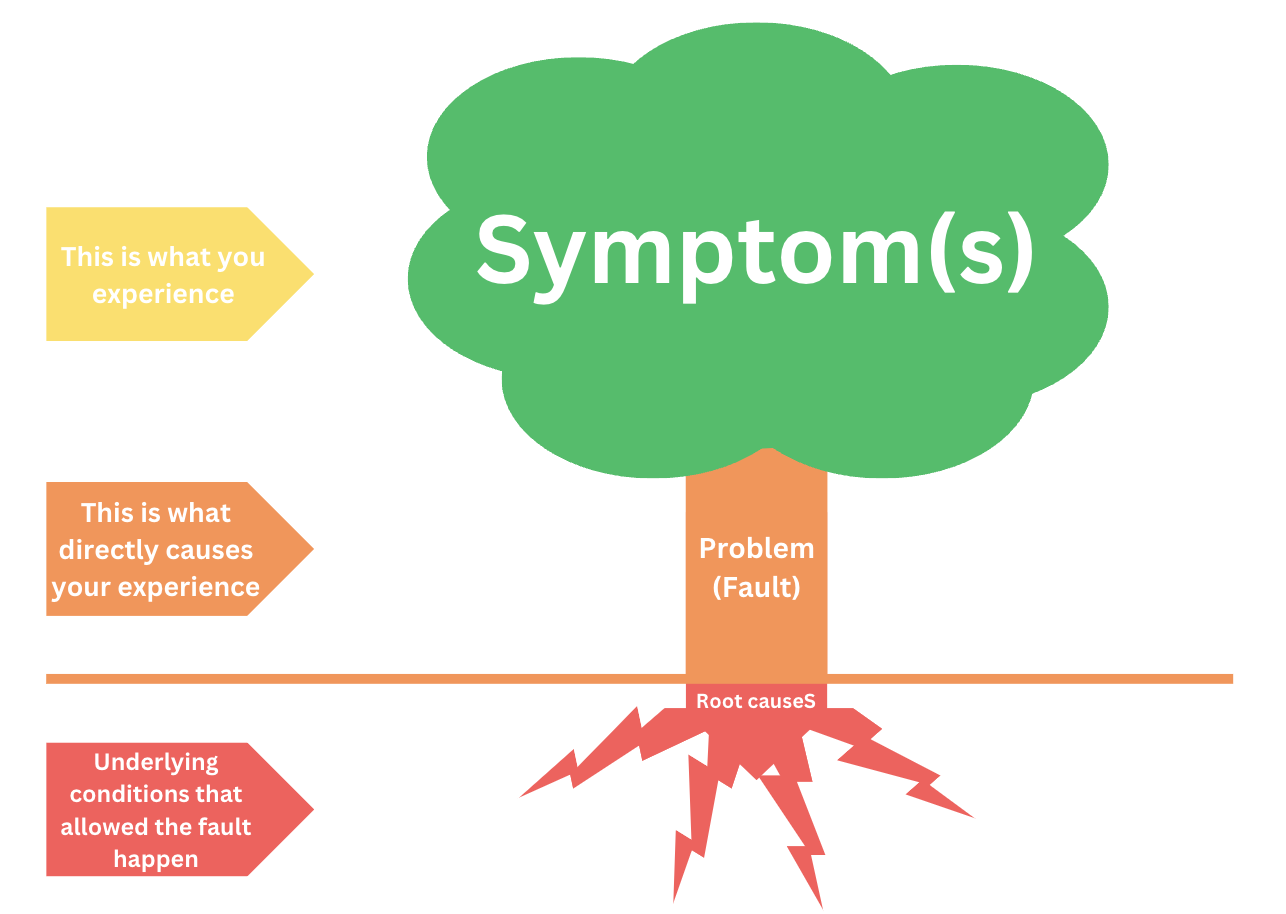
This is an illustration of the root cause and the symptoms that stem from it
Image taken from https://www.marcinsocha.pl/root-cause-analysis-theoretical-introduction-and-why-it-matters-vol-1/
The easiest way to understand root cause analysis is to think about a little example:
Problem: The Jefferson Memorial is deteriorating.
Why: Why is the monument deteriorating?
Answer: Because the monument needs to be cleaned regularly.
Why : Why does the monument need to be cleaned often?
Answer: To get the bird droppings off the monument.
Why: Why are there bird droppings on the statue?
Answer: Because there were a lot of spiders and the birds ate the spiders.
Why: Why were there so many spiders?
Answer: Because there were a lot of mosquitoes and the spiders ate the mosquitoes.
Why: Why were there so many mosquitoes?
Answer: Because the lights attract insects in the evening.
Now, they could have applied all sorts of “band-aids” by scaring the birds away in various ways. They could have placed scarecrows, played ultrasonic sounds, or set up bird spikes. But ultimately, none of this would have made a difference, because the birds would have returned anyway due to the abundance of food. By turning off the lights earlier, not only were there fewer mosquitoes—and consequently fewer spiders and birds—but with this improvement, the organization also saved money on energy costs.
Link to video abput the Lincoln Memorial
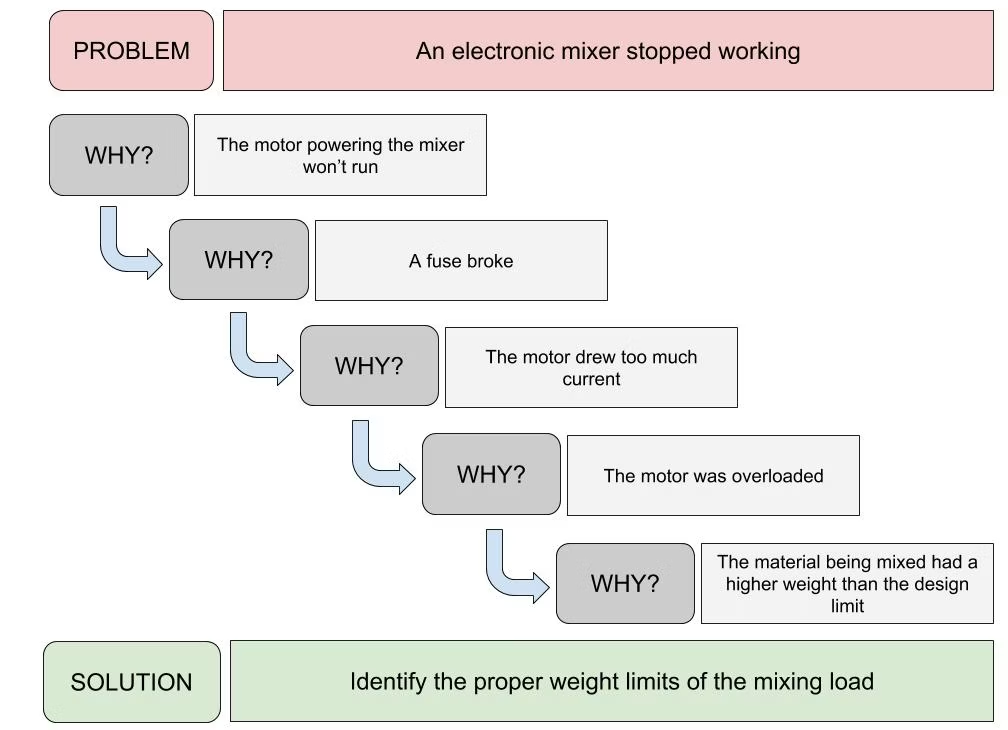
Let’s take a more grim example now, where the stakes were much higher than some damaged stone:
Problem: 150 people were killed
Why (1): Why were they killed ?
Answer (1): Because they were on Germanwings flight 9525, which crashed.
Why (2):Why did Germanwings flight 9525 crash?
Answer (2):Because the pilot crashed the plane on purpose.
Why (3): Why did the pilot crash the plane on purpose?
Answer (3): Because he was suffering from depression and wanted to commit suicide.
Why (4): Why was he allowed to fly planes if he was suffering from depression?
Answer (4): Because he had a valid medical record that stated he had cured his previous episode of depression, which he had reported.
Why (5): Why did he not report that his depression came back?
Answer (5): Because if he would have reported it, then he would have lost his medical record forever and not been able to fly for the rest of his life.
Why(6): Why would he have lost his medical record now if before he had the option to take time off to cure his depression and come back when he was okay?
Answer(6): Because regulations stipulate that to keep a valid medical record, you can have depression maximum only once in your lifetime and if it comes back you lose your record forever (and thus the dream job of being a pilot that was achieved by a lot of hard work)
Solution: Fix those regulations and have a support system for pilots going through depression to secure their jobs while allowing them to take time off to cure their depression.
PS: this is still an ongoing issue and those regulations are still in place, so sleep tight before your flight and think of Root Cause Analysis 🙂
Watch the video about the Germanwings crash
How to do root cause analysis?
4 or more WHYs?
One of the more common techniques in performing a root cause analysis is the 5 Whys approach . We may also think of this as the annoying toddler approach. For every answer to a WHY question, follow it up with an additional, deeper “Ok, but WHY?” question. Children are surprisingly effective at root cause analysis. Common wisdom suggests that about five WHY questions can lead us to most root causes—but we could need as few as two or as many as 50 WHYs.
Example: Let’s think back to our football concussion example. First, our player will present a problem: Why do I have such a bad headache? This is our first WHY. First answer: Because I can’t see straight.
Second why: Why can’t you see straight? Second answer: Because I my head hit the ground.
Third why: Why did your head hit the ground? Third answer: I got hit tackled to the ground and hit my head hard.
Fourth why: Why did hitting the ground hurt so much? Fourth answer: Because I wasn’t wearing a helmet.
Fifth why: Why weren’t you wearing a helmet? Fifth answer: Because we didn’t have enough helmets in our locker room.
Aha. After these five questions, we discover that the root cause of the concussion was most likely from a lack of available helmets. In the future, we could reduce the risk of this type of concussion by making sure every football player has a helmet.
The 5 Whys serve as a way to avoid assumptions. By finding detailed responses to incremental questions, answers become clearer and more concise each time. Ideally, the last WHY will lead to a process that failed, one which can then be fixed.
Change Analysis/Event Analysis
Another useful method of exploring root cause analysis is to carefully analyze the changes leading up to an event. This method is especially handy when there are a large number of potential causes. Instead of looking at the specific day or hour that something went wrong, we look at a longer period of time and gain a historical context.
- First, we’d list out every potential cause leading up to an event. These should be any time a change occurred for better or worse or benign. Example: Let’s say the event we’re going to analyze is an uncharacteristically successful day of sales in New York City, and we wanted to know why it was so great so we can try to replicate it. First, we’d list out every touch point with each of the major customers, every event, every possibly relevant change.
- Second, we’d categorize each change or event by how much influence we had over it. We can categorize as Internal/External, Owned/Unowned, or something similar. Example: In our great Sales day example, we’d start to sort out things like “Sales representative presented new slide deck on social impact” (Internal) and other events like “Last day of the quarter” (External) or “First day of Spring” (External).
- Third, we’d go event by event and decide whether or not that event was an unrelated factor, a correlated factor, a contributing factor, or a likely root cause. This is where the bulk of the analysis happens and this is where other techniques like the 5 Whys can be used. Example: Within our analysis we discover that our fancy new Sales slide deck was actually an unrelated factor but the fact it was the end of the quarter was definitely a contributing factor. However, one factor was identified as the most likely root cause: the Sales Lead for the area moved to a new apartment with a shorter commute, meaning that she started showing up to meetings with clients 10 minutes earlier during the last week of the quarter.
- Fourth, we look to see how we can replicate or remedy the root cause. Example: While not everyone can move to a new apartment, our organization decides that if Sales reps show up an extra 10 minutes earlier to client meetings in the final week of a quarter, they may be able to replicate this root cause success.
Tips for performing effective root cause analysis
Ask questions to clarify information and bring us closer to answers. The more we can drill down and interrogate every potential cause, the more likely we are to find a root cause. Once we believe we have identified the root cause of the problem (and not just another symptom), we can ask even more questions: Why are we certain this is the root cause instead of that? How can we fix this root cause to prevent the issue from happening again? Use simple questions like “why?” “how?” and “so what does that mean here?” to carve a path towards understanding.
References
https://www.tableau.com/analytics/what-is-root-cause-analysis
https://leansixsigmagroep.nl/lean-agile-en-six-sigma/root-cause-analysis/?
srsltid=AfmBOorrPVv8XoYI2fa2LsJsUQVfdEtoWBjHSl9NDNMGai5vEj4wDhIJ